Floral Books Embroidery Design
First Impression: Warm, Whimsical, and Instantly Relatable
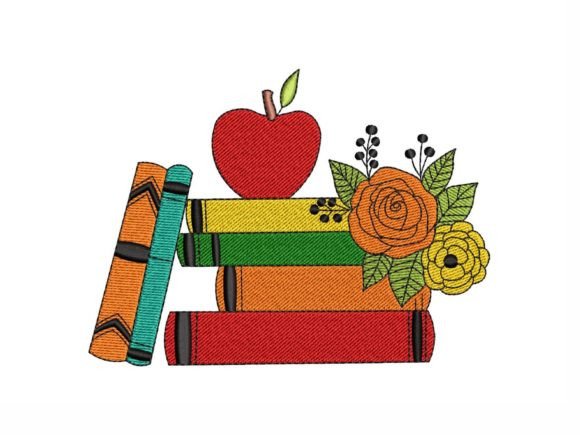
As an embroidery designer who’s prepped over 200 craft fair booths—and watched thousands of shoppers pause at a table—I’ll tell you straight: Floral Books lands with quiet confidence. It’s not loud or trendy; it’s softly elegant, gently rustic, and warmly intellectual. The mental image—a stack of books crowned with a juicy apple and delicate florals—evokes classrooms, cozy reading nooks, and thoughtful gifting. It reads as premium handmade, not mass-produced. That matters when your booth is packed with 37 other makers and someone glances for just three seconds.
Where Floral Books Shines on Craft Fair Products
This design isn’t one-note—it flexes beautifully across product types, but not equally. Here’s where it delivers strongest:
- Tote bag design: Centered on a natural canvas or oatmeal linen tote, Floral Books reads clearly from 6 feet away. The stacked books provide vertical rhythm; the apple adds a pop of implied color (even in monochrome thread); the florals soften the geometry. Ideal for teachers, librarians, and indie bookshop lovers.
- Apron embroidery: Positioned just above the pocket or centered on the bib, it feels intentional—not cute, not cluttered. Works especially well on unbleached cotton or chambray aprons that let the stitch texture breathe.
- Tea towel embroidery: A single Floral Books motif near the corner or centered on the hem gives instant charm without overwhelming the fabric’s utility. Avoid dense stitching on terry cloth—we’ll get to that.
- Embroidered patch: At 3–4 inches wide, this design scales down gracefully. The books retain legibility, the apple stays plump, and the floral stems read as delicate lines—not mush. Perfect for badge reels, denim jackets, or teacher gift sets.
- Pillow cover & small pouch: As a focal point on a 12" square pillow or 5" zip pouch, Floral Books feels curated and giftable. Buyers consistently reach for items that whisper “I chose this *for you*”—and this design does exactly that.
Where It Needs Careful Placement
Floral Books isn’t built for every surface. On curved or rigid substrates, subtlety becomes vulnerability:
- Caps: The horizontal stack of books stretches awkwardly across a curved crown. Unless resized and re-proportioned for low-profile cap hoops, detail loss is likely—especially in the floral stems and apple stem.
- Dark fabric: Without high-contrast thread colors (e.g., ecru on navy, or white on charcoal), the apple’s roundness and floral outlines can visually flatten. Always test thread contrast on your base fabric—not just swatches.
- Textured towels: Heavy waffle or looped terry absorbs fine stitches. If your Floral Books embroidery file includes tight floral fill or thin stem lines, those will vanish unless stabilized aggressively and stitched with reduced density.
Real-World Selling Strengths
This isn’t just about prettiness—it’s about conversion. At craft fairs, Floral Books performs because it’s:
- Instantly legible—no decoding needed. Books + apple + flowers = “reader,” “teacher,” “learner.” No slogans required.
- Highly repeatable for batch production. Its balanced composition avoids extreme angles or asymmetry that throw off hooping consistency.
- Photogenic—clean lines, organic shapes, and natural negative space make it easy to light and shoot for Etsy listings or Instagram. A printable mockup with soft shadow and linen background sells faster than raw photos.
- Booth-cohesive: Pair it with muted thread palettes (sage, terracotta, cream, slate) and it anchors a whole School-themed collection—without shouting. That builds perceived brand consistency, even for small shop products.
Designer Notes You Can’t Skip
Before cutting your first stabilizer sheet, do these six things:
- Test the machine embroidery design on scrap fabric matching your final product—same weight, same weave, same dye lot.
- Check thread colors against your fabric under both daylight and booth lighting. That “juicy apple” only reads if red or coral thread pops—not blends.
- Review spacing between book spines and floral elements. Tight gaps may collapse on thicker fabrics; open them slightly if needed.
- Confirm hoop size compatibility. If the full design exceeds 5×7", consider offering a simplified version for smaller hoops—many crafters won’t upgrade just for one design.
- Inspect stitch density. Dense floral fills on tea towels or pouches = puckering. Lighten fill density by 15–20% for textured or stretchy substrates.
- Use cutaway stabilizer for woven fabrics, tear-away for stable linens—and always baste first. One loose edge ruins the clean look Floral Books promises.
Final Thought: Why This Belongs in Your Next Batch
Floral Books isn’t just another embroidery file—it’s a quiet sales catalyst. It draws the “bookworm” buyer, the “gift-panicked aunt,” the “first-year teacher” scrolling Etsy at midnight. It works on tactile, functional handmade products where quality is felt—not just seen. And because it bridges School relevance with universal warmth, it sidesteps seasonal limits. You won’t sell 500 units in a day—but you’ll sell 12 meaningful ones, each attached to a story, a thank-you note, or a repeat customer who remembers your booth. That’s how small shop products grow into trusted brands. Just remember: before you list it, stitch it, or hang it, treat Floral Books like the considered, hand-crafted asset it is.